
Intro to Racing: So Who Actually Won?
July 1st, 2026 by team
by B.J. Porter (Contributing Editor)
“Your Majesty, there is no second.”
Supposedly said in response to Queen Victoria, when she asked who was in second place behind the yacht America in 1851 in the first race for the 100 guinea cup.
In the last few months, we went through a lot of the basic materials for new racers. We started with why you really should try racing, then talked about your first race, next we covered the madness at the race start, then on keeping your head at mark roundings.
There’s a lot more we could cover, like wind shifts, picking a side of the course, crossing and covering boats, and several other more advanced topics. The keyword is advanced, and we’re still focusing on the basics in this series. If there’s interest down the road, we can get into those some day.
Hopefully, a few of you have found rides on race boats for the summer and are seeing some of this in action. If you’ve completed your first races, then you may have some questions about how it all worked out in the end. And for the rest of you, we can make it clear just how a winner is determined.
And yes, for those of us not racing in the America’s Cup, there is indeed a second place!
Who is the winner (easy version)?
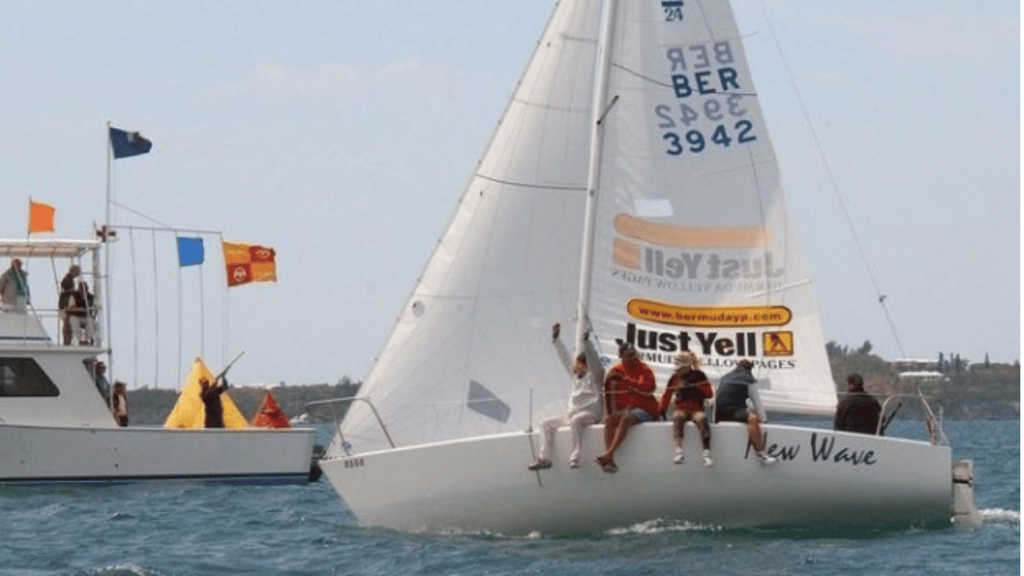
“So, the first boat over the line won the race, right?” That’s a logical question.
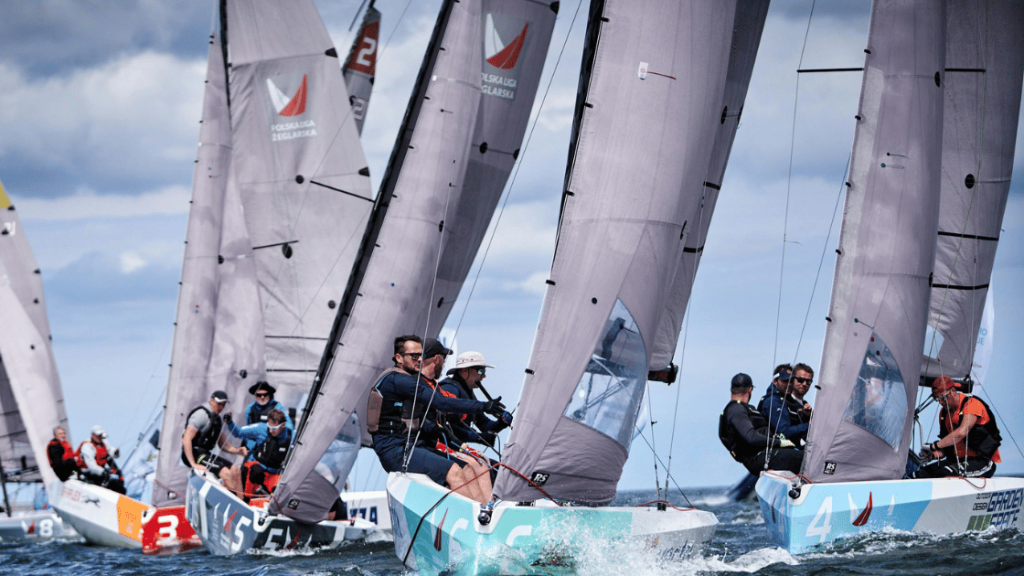
But the answer is “sometimes.” It depends on the type of racing. If the boats racing each other are all one-design boats, racing using one-design class rules, then the winner is simply the first person over the line.
In a fleet where all the boats are the same, the order over the finish line is the score you receive. Sometimes there’s a minor question over a super-close finish where the race committee will make a call, or there may be unresolved protests during the race to resolve.
But in its simplest form, identical racing boats racing only against identical boats makes for very easy scoring.
Who is the winner (math meme version)?
So when is the first boat over the line not the winner of a race? When the boats race racing in a mixed fleet of different boats. Handicaps are used to score the boats in that case, and the boat with the lowest corrected time wins the race.

What is a boat handicap?
A racing handicap is a number assigned to a boat that is used to adjust its finish position relative to other boats. It s like a golf handicap, which allows a less skilled golfer to compete with better golfers. The score is adjusted by their handicap to get a final score to determine the winner.
It’s similar in sailing, except for two key differences. First, the adjustment is for the speed of the boat as configured for racing, not for the skill of the skipper or crew. Second, the adjustment is made to the finish time, not the number of swings of a club.
And an example (using PHRF time on distance, if that makes any sense!)
Suppose two boats are racing under a handicap system that gives a seconds per mile adjustment to every racing boat. So for every mile of the race, their handicap rating corrected the finish time for each boat to get a final finish time. The handicap-adjusted time determines the final score for all boats.
For simplicity, most use the fastest boat in the fleet (the scratch boat) and subtract the other boat rating differences from the scratch boat and just adjust the slower boats.
The faster boat (Boat A) has a rating of 54; the slower (Boat B) rates 72. Boat A has a handicap 18 seconds/mile lower than Boat B.
So one could say that Boat A “owes” Boat B 18 seconds per mile, so Boat B’s finish time would be reduced by 18 seconds for every mile of the race. (the calculation is a little simplified here)
Suppose these boats do a six-mile race. Boat A completes the course in one hour, eight minutes and 15 seconds (1:06:15). Boat B crosses the finish line a minute and a half later, at 1:07:45.
Who won? To figure this, we take the 18 seconds per mile difference and multiply it by 6 miles, leading to a 108-second reduction to Boat B’s finish. So their time corrects from 1:07:45 to 1:05:57 (1 hour, seven minutes, 15 seconds minus 108 seconds). So on corrected time, Boat B beats Boat A by 17 seconds.
They would present the results as:
| Boat name | Handicap | Finish Time | Corrected Time | Place |
|---|---|---|---|---|
| Boat A | 54 | 1:06:15 | 1:06:15 | 2 |
| Boat B | 72 | 1:07:45 | 1:05:57 | 1 |
And you can have a complete list of boats in a class racing with different handicaps, apply the calculations to all of them, and come up with who won, came in second, third, and so on by adjusted finish time.
Handicap Systems

There have been many attempts in the history of yacht racing to find a “perfect” handicap system that correctly adjusts for all differences in boats across all ranges of conditions. It’s an impossible task because there are so many boats, and all of them have some conditions in which they truly excel, and other conditions in which they might be weak.
For example, a flaw in the example system (time on distance) we use above is that some boats are better in light wind, and some are better in heavy wind. But they use the same handicap for all conditions, so if there is big breeze it will favor one boat, and light air will favor another.
The other challenges are differences in boat condition and setup. Two identical boats are rarely identical unless they’re closely constrained by a one-design rule. Sister ships might have different equipment installed, or different rig changes, or have different weights. When I raced a Beneteau First 40.7, there was no one-design class. So we decided to use a slightly oversized spinnaker pole and spinnaker. For this, we took a rating change of -3 seconds per mile. Because that change to the stock configuration made us slightly faster than an otherwise identical stock boat.
Some handicap systems take self-reported data and keep it simple; some make you strip the boat to factory new condition and weigh it! If you then race with full water tanks and a shelf full of hardbound cruising guides on board, that extra weight and loss of speed is on you!
Time-on-time (ToT) vs. Time-on-distance (ToD)
The example race was an example of a time-on-distance correction. It has the simplest math, and the results are pretty easy to figure out on the course. If you know you owe the boat off your stern six seconds a mile, you can cross the line then wait for them to finish with a stopwatch and figure out if they beat you.
Time on time is a bit more subtle and can be harder to figure out on the fly. But adjusting the correction by the overall time of the race allows for smaller corrections for faster (higher wind) or slower (light air) races, and it also scales with distance.
PHRF (Performance Handicap Racing Fleet)
This is a very common handicap system in the U.S., as it is simple and easy to calculate, and ratings are largely based on self-reported data. Many yacht clubs will use it for weekly race series. While some don’t like it because it’s somewhat imprecise compared to other systems and has regional variations, its ease of use and low cost to implement and administer.
Races are scored easily on ToD format, but there is a relatively simple formula to convert ToD handicaps to a “time multiplier” which can be used for ToT correction. Race committees have further discretion to adjust time-on-time corrections based on prevailing conditions for more accurate results.
PHRF is managed by regional PHRF committees, which fall under the larger umbrella of U.S. Sailing. But if you plan to race under PHRF in multiple locations, you may need multiple certificates, and your ratings may be slightly different. As a racer based in Narragansett Bay, RI, I had to get a PHRF-NB (Narragansett Bay) certificate for races in my home waters, and a PHRF-NE (New England) certificate for regional races around New England.
IRC (International Racing System)
This is one of the newer rating systems which has gained a lot of traction globally. Most major regattas use it. It’s primarily a ToT correction, and it factors in a detailed measurement of every boat with a certificate. Sometimes boats even need to be weighed for proper rating, though production boats with good data can often skip this.
Unlike PHRF, which has regional variations, U.S. Sailing manages IRC certification and rating in the U.S. Though U.S. Sailing is the IRC Rule Authority for the United States, IRC globally is owned and managed by the Royal Ocean Racing Club (RORC, UK) and the Union Nationale pour la Course au Large (UNCL, France).
ORC, MORC, ORR, etc.
Several other accepted handicap standards exist, and some races will only score under those rules and require handicap certificates to compete. Most of these are less common and used mostly for offshore racing or for more specialized boats like multihulls.
How can you know you are winning?
Sometimes, knowing if you won a race means you have to wait for the results to be posted by the race committee. This is usually the case with large mixed-fleet races using ToD handicaps, which are not readily known by racers when they’re on the water.
So the best you can do is study the scratch sheet (the list of entered boats in your class and fleet), and learn which boats you will compete against and roughly how their ratings stack up to your boat.
For ToD PHRF races, you can figure out the winner if you know the race length and handicaps and hang around the finish with a stopwatch.
For the rest, it’s most important to know which boats are slower (you owe time to), and which are faster and owe you time. If you cross the finish line before or immediately after a boat which owes you time, there’s a good chance you beat them. And if a boat you owe time to is right on your tail or worse, finishes first, well you can figure out what happened by now.
With that knowledge, you can adjust your tactics based on which boats are around you.
Getting the final scores
Almost every race includes an after-event where they report scores and share results. Whether it’s a handful of Laser sailors sharing a cooler in the parking lot after they’re done, or a big tent at a regatta sponsored by a rum company, it’s usually a fun social part of the race. The official results will be posted, and the winners get announced.
The good news for you as a crew member is you don’t really have to understand the scoring in deep detail, as long as your head is in the game about which boats to watch for. Until you get your own boat or get moved back to the “brain trust” making tactical decisions at the back of the boat, when the race is over you can pitch in to clean up, the kick back and enjoy the after party.
Waiting for the scores is actually one of the good parts of racing because you have time to meet other sailors and talk about what happened on the water. You get to learn a lot, meet many new people, and sometimes bask in the glow of a podium finish with your team.
And that’s what you’re there for, too.

Leave a Reply