
Why Racing Sailboats Might Be the Most Fun You’ve Never Tried
January 16th, 2026 by team
by B.J. Porter (Contributing Editor)
For many people, the answer to “Will I like sailboat racing?” is unequivocally “yes!” Of course, it’s not for everyone, and sometimes it takes getting out there for a race or three to figure that out.
But the real question for people who’ve never raced but are curious about it is, “What is racing all about?”
To answer this, we’re introducing another series throughout the next year on the basics of racing sailboats (or just “racing” from now on!). The target audience is those who are racing-curious, those fairly new to racing, or those experienced racers who might hope to recruit more friends to this fantastic sport and have something to add to the discussion.
We’ll talk about how a race works, what types of racing are out there, what types of racing may be right for you, and how you can get involved in your first races. As we progress, we’ll get into more details about each phase of a race, from pre-starts and starts, through mark roundings, and all the way to finishes, scoring, and protests. We’ll also explore how you can get better at racing, making yourself more useful on a crew, and how you can start racing better on your own boat. We’ll even get into boat speed, boat preparation, and tactics.
It’s a rich topic, and we’ll start with the basics and work our way down the course over the year to the more advanced topics after we’ve laid the foundation.
So…who’s ready to go race some sailboats?
What the heck is going on out there?
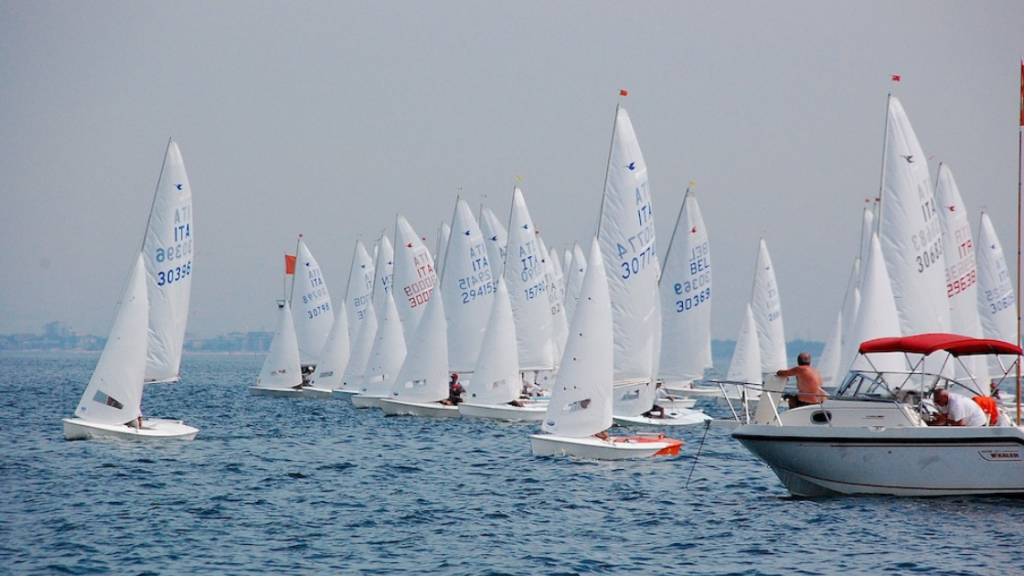
If you head out on the water in a place like Newport, RI, any summer evening, you’ll see groups of boats all heading mostly in the same direction. Sort of.
They may all be the same, or it may be many types of boats. Of course, from a mile away it’s hard to tell exactly what’s going on with those boats. If you’ve never raced, it can be pretty confusing to sail through. Once we teach you a bit about how it works and zoom in for a closer look, it will make more sense. Trust me on this – it’s a lot easier than figuring out cricket!
Please note: There are a lot of exceptions in races to meet local needs or race requirements in how races are run and rules applied. So I’ll skip all the “usually” and “most of the time” qualifications to keep the words flowing. We’ll get to the exceptions when we get into more detail in subsequent articles.
Race Basics
At its simplest, a sailboat race is a group of boats sailing the same predetermined route to see who finishes first. A regatta is a collection of multiple races organized into a single scored event. A regatta may be a series of ten races on Wednesday nights throughout the summer, a handful of races over a weekend, or even a single race. The race results are combined to find the overall regatta winner.
The Racing Rules of Sailing (RRS) govern races in the U.S. and most other countries, and World Sailing revises and updates them every four years. These rules explicitly guide how races work, how boats interact, and how disputes are resolved.
The current edition of the RRS is 2025-2028, and you can download a PDF of the rules for free if you want to read ahead. Do not let the language intimidate you at the beginning of your racing career. It makes much more sense once you’ve gone through a couple of actual races.
On the water, the Race Committee (RC) has a designated boat full of people (the Committee Boat) trained to run races. They run the timing, put up signal flags and make the correct sound signals, and score the finishes. There may be one or more additional mark boats or safety boats out there to move floating marks and watch mark roundings.
Marks and Courses
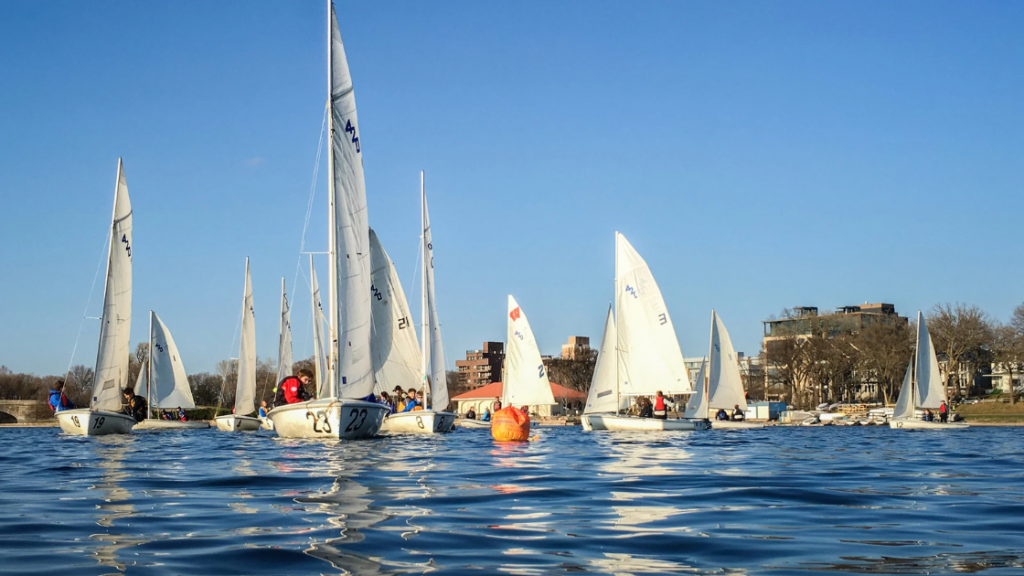
A course may be a collection of floating buoy marks dropped for race day, a series of government marks, or for distance races, major land features or coordinates. If the course is around fixed marks, the committee will provide the courses ahead of time, though the exact course may be selected on race day. But many shorter races will drop floating marks the day of the race with positions based on wind conditions. When the race organizers set the course, they communicate that information to the fleet on the water.
Every race has a starting line, an imaginary line drawn from the committee boat to a mark in the water known as the pin. When the race starts, boats cross the line in the same direction, heading to the first mark. The boats must sail the course the same way, rounding each mark on a specific side in a specific order a set number of times. Boats may not skip or touch any marks.
It doesn’t matter how a boat gets to a mark, only that it rounds the mark in the proper way.
Starting Races
All races start with a countdown, usually five minutes. Dinghies may run shorter sequences, but the stages of the start are the same.
The goal of the start is to hit the starting line right as the start timer runs out with your boat going full speed. You also want to seize the best tactical position, or at least not end up in a terrible one. A poor start is tough to recover from.
The Warning signal starts at five minutes out, followed one minute later by a Preparatory signal and flag. This is the formal start of the race; all race conditions and rules apply. For example, if your engine is still running, you will be disqualified.
One minute before the start, the Preparatory (or “Prep”) flag comes down, and the RC makes a longer sound. When the countdown timer reaches zero, the race begins. The race committee makes a horn or gun sound, and boats may cross the start line.
The five-minute start sequence is intimidating to new racers, since boats are milling around in tight quarters, jockeying for position to get the best possible start. There is often shouting and confusion between boats as competitors assert their rights of way and crews communicate over the din.
Then suddenly in the last few seconds the fleet usually organizes itself as everyone settles in to build speed and make their timed approach to the line.
If you cross the start line before the starting signal, you will be penalized and have to re-cross the line before you start.
Sailing the legs
Once the boats start the race, they make their way along the course towards each mark in order. As boats meet on the water or sail closer to each other, the RRS governs how they interact and which boat must give way to other boats as they cross on the water.
The rules are important as boats approach marks. These are natural constriction points on the course, and many boats converge at the same time. This can be as hectic as the start, as the crew swaps sails for the next leg and the driver steers the boat around the mark while complying with the rules, avoiding other boats, and not touching the mark.
Finishing Races
While the boats run the race, the race committee readies for the finish. They often use the start line as the finish, so the committee boat doesn’t have to re-anchor and drop a new pin.
The committee blows a horn for every boat as it crosses the line, showing they’ve finished and had the finish time recorded. The first boat across the finish line in a class may get a special sound, like a cannon or blast. Every boat gets scored with a finish time unless it doesn’t finish the race.
Scoring options
There are many ways to score fleet races. The most common include:
- Straight time scoring. In one-design racing, all boats in a fleet are identical. The order of the boats crossing the finish line determines their scores. Elapsed or finish time isn’t important, only the order they finish.
- Handicap. In fleets made of mixed boat types, every boat has a “handicap” to adjust its finish time. The final position is calculated based on the adjusted finish time. There are several popular handicap rules we’ll address in a later article.
- Pursuit racing is a variation of handicap racing, popular in more casual distance races. Boats start at staggered times based on their handicaps, with slow boats given a head start on fast boats. In ththeory,ll boats should finish at the same time. Actual times are recorded and scored accordingly.
In match racing, there are only two boats. So the boat that crosses the line first wins; finish time is irrelevant.
Types of racing
From the terminology we’ve thrown around above, it should be clear there are many types of racing, and many ways to conduct and score racing. From the highest levels of racing like the America’s Cup, down to casual racing with a small group of friends on the same body of water, the options are almost endless.
Fleet Racing and Match Racing
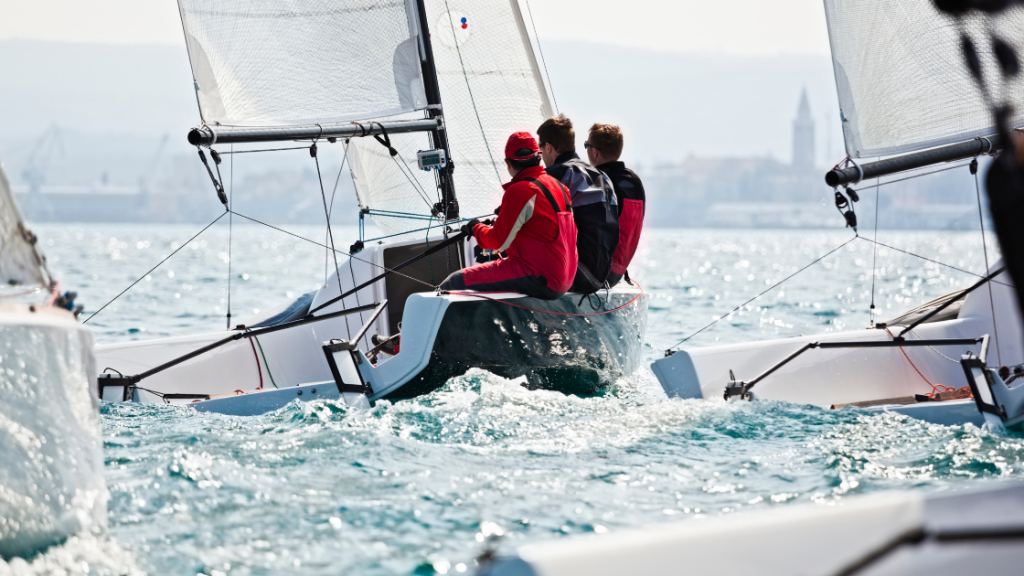
Most races are fleet races, with many boats sailing and competing against each other to earn the top finishes in the fleets. The dynamics are different with a lot of boats on the water, as are the rules. Fleet races can run from two boats up to fleets of hundreds of boats.
Organizers categorize larger fleets into classes and group and score boats by relative speed and capability. In mixed-fleet racing, it’s much more fun to race against six to ten similar boats than it is to be “racing” against one boat out of a massive fleet that you never see after the start because it is so much faster or slower than you. Large events also recognize overall fleet performance, and they usually award prizes and scoring for each class. Staggered starts for each class keep things more organized.
Match racing is one boat on one boat, and there are special sections of the rules governing match races. The best-known match race is the America’s Cup, where boats race head-to-head over a series of weeks and months to reach an eventual winner.
There are other variants like team racing, which is fleet racing with groups of boats scored together as a team against other teams.
Distance and offshore
Long-distance races are popular, and usually head offshore outside enclosed waters. They range from day-long regional events to races around the world. Distance racing really isn’t for the beginning racer or sailor, but it’s a good aspirational goal.
Around the buoys
The most common racing at the “club” level is around the buoys racing. Race committees set courses according to the wind conditions, choosing race directions and distances. Usually, there are a few laps around the course to complete one race. Dinghy and small boat racing is almost always around the buoys.
A very common course design is a windward/leeward course, with the first rounding mark straight upwind, then heading downwind to round a downwind mark. This course presents some of the most challenging sailing since neither mark heading gives easy, direct steering and forces many tactical choices.
One Design vs. Handicap
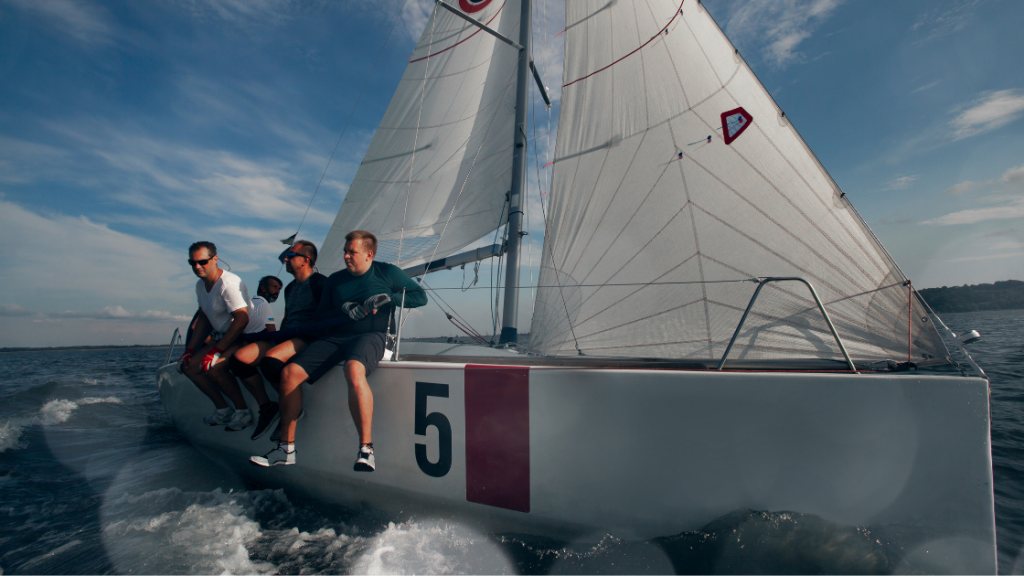
Above we mentioned “one design.” Certain models of boats are popular because they have established rules for boats in class-specific events. These rules ensure all boats are as close to identical as possible, and don’t allow for modifications to change performance. It eliminates the boat as a factor in a race, at least in theory, because only that design of boat can race.
Handicap racing allows fleets of dissimilar boats to compete directly. It’s analogous to a golf handicap, in that the raw score is adjusted by a handicap to get a final net score so a weekend duffer can play a round with the club pro and still have fun. The difference is that while a golf handicap is based entirely on the skill of the golfer, racing handicaps are based on the make and configuration of a boat. Crew skill does not factor into it.
All participating boats need a handicap certificate from the appropriate body to compete in the races.
Note that there is nothing stopping someone with a one-design boat from joining in handicap fleet racing. All they need to do is apply for a rating to race under.
Big Boat, Small Boat
Racing happens in all types of boats, from tiny one-person dinghies only six feet long up to hundred-foot maxi yachts run by professional crews. The rules are essentially the same, though there’s a lot more casual racing of small dinghies with relaxed rules and major events often have special considerations.
Levels of racing
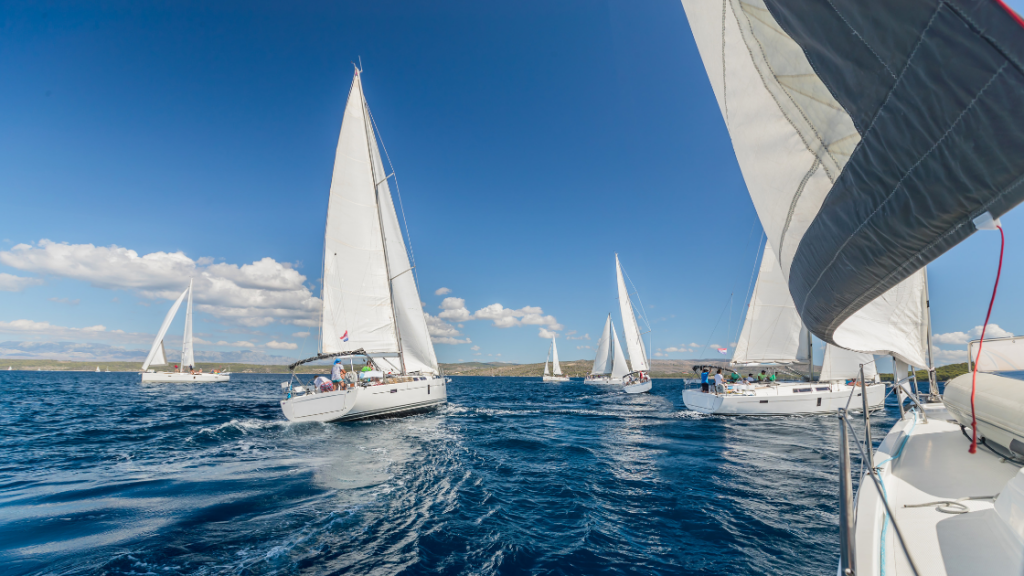
Like golf, participation in racing runs from groups of friends playing a round, to local club tournaments and leagues, all the way to the PGA Tour of professionals. The biggest difference is that there isn’t much prize money to speak of in racing. Boat owners and owning syndicates fund racing, but they aren’t making a living at it. Paid professionals make up most of the crew at the world-class events.
But most racing is “club level,” which is much closer to a local golf tournament or weekly golf league at a public course. It’s regular folks coming out to play on a mostly level field just to have fun with the sport. There’s a load of fun on the water, and many races have some sort of get-together later, even if it’s just a round of drinks in the club bar to swap stories and jokes about the day’s racing.
The vast majority of us will never turn pro, and it’s a tough and unpredictable lifestyle. Unless we’ve been racing since our youth, we’re unlikely to reach that elite skill level. We’re just out there to have a good time. And in the end, that’s what it’s all about.
How you can start racing
Racing your own boat for the first time is intimidating if you don’t know what you’re doing. There are rules to know, and you need the skills to thread your way through those complicated starting and mark rounding dances without making a mess of things. You’re close enough to other boats that you will hear their displeasure if you unwittingly foul them, or worse, collide.
If you want to race your own boat, you’d do best to find a mentor. Someone who has raced before, who can sit next to you and help teach you how to make sense out of what looks like a lot of chaos the first time you leap into it.
A great approach is to find a ride on someone else’s boat at a club race. Most club race fleets have multiple classes, with the fastest and best sailed boats grouped together. And there will be classes of smaller and slower boats, and many of those boats are always looking for new people to come out with them. Even rank beginners. Nothing is worse than getting all ready for race night and not having enough people on board to race well. So you don’t need loads of skill – if you show up with a willing attitude and can listen and learn, you will find a ride.
If you belong to a yacht club, start there. Or start at nearby clubs and ask around about the racing and who might need crew. If that doesn’t work, find out about races in your area, dress for sailing, and show up at the docks a couple of hours before race time. Look for the busy boats getting ready and ask around. You just might get lucky.

January 17, 2026 at 4:49 pm, Alan Shedd said:
Thanks, I hope this will encourage more people to give racing a try. As the article suggested, crewing on someone else’s boat is a great way to start, racing sailors always need crew – even without experience. The most important thing is to be flexible, willing, and show up. Initially, as a cruising sailor, I had little interest but I got hooked and have been racing for 40+ years. It’s a great way to build boat handling skills too
January 18, 2026 at 8:52 pm, Roger Briggs said:
To emphasize what Alan said, racing makes you a better sailor. A better sailor is a safer sailor. Sailing puts you in situations that you may never be in if you’re always just cruising, so your boat handling skills improve.
January 29, 2026 at 6:15 pm, Roger Benedict said:
Great article! I’m the race chair at Lake Keowee SC sailing club, and just shared this in our monthly newsletter. We want to bring sailors into the fun of club level racing. Thank
s for sharing how much fun sailboat racing can be, and how to get started
February 01, 2026 at 5:23 pm, B.J. Porter said:
It’s always encouraging to hear about racing in places that us coastal sailors wouldn’t expect. We sort of assume it’s all about where we are, but there are so many big lakes all over the country with racing fleets.
I was delighted to learn last summer that a large inland lake near my parents in Virginia had not one but two different racing fleets!
Keep up the good work, and thanks for your volunteering to grow the sport.
P.S. those MC Scows always looked like fun boats!
February 11, 2026 at 3:04 am, Koen Velazquez said:
Very well presented. Every quote was awesome and thanks for sharing the content. Keep sharing and keep motivating others.