
Boater’s Guide to Engines II: The Four-Stroke Engine
February 13th, 2026 by team
Part I:Boater’s Guide to Engines: The Internal Combustion Engine
by B.J. Porter (Contributing Editor)
Last month we kicked off a multi-part series on boat engines and propulsion. Since we build on what we learned in the introductory article, it’s worth a read if you haven’t had a look.
This month, we’re taking a deeper look at the four-stroke engine. How it works, how it’s different from a two-stroke, and what the strengths and weaknesses are in the four-stroke. Of course, it will be nearly impossible to discuss all this without using the two-stroke engine as a comparison. But the focus is on the four-stroke.
Note that most of what we’ll cover applies equally to diesel and gasoline engines. While there are significant differences between the two types of engines, the strokes in the combustion cycle are basically the same.
Four-stroke Differences
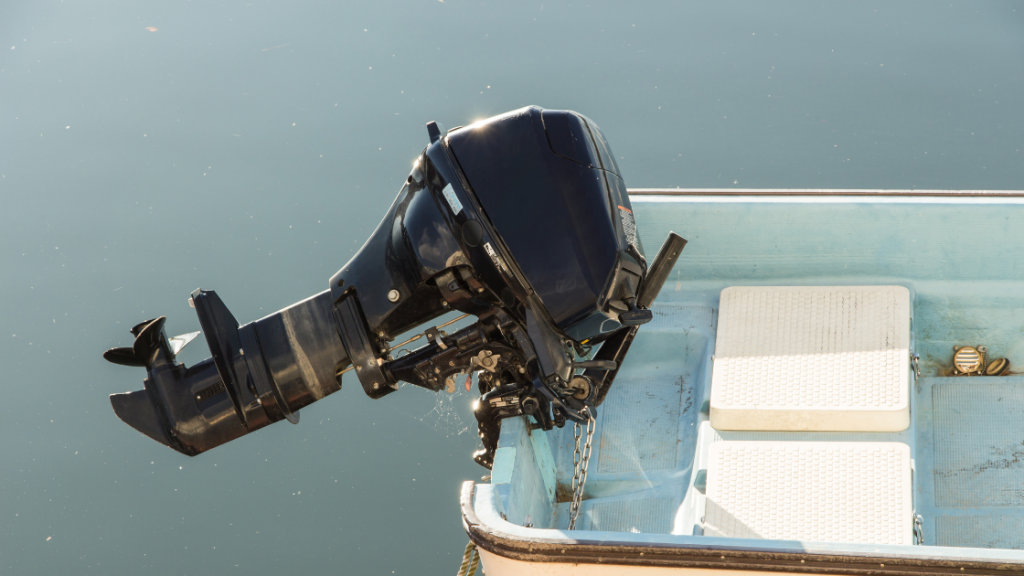
Years ago, we had a new 9.8 HP four-stroke engine on our dinghy. It ran smoothly, used little fuel, and was so quiet you could forget to turn it off if you were in a hurry and didn’t notice the noise. And my wife hated it.
Why did she loathe the engine? Primarily because she couldn’t start it reliably. My wife is not a large person, and she just could not pull hard enough to start that engine reliably, especially if it was cold. So she could not take the dinghy by herself. With our plans to live onboard and cruise to other countries, we had to solve this problem.
Our options included adding an electric start, but that meant replacing the engine with a bigger, heavier one and adding a battery. Eventually, we switched to a 15 HP two-stroke engine. And the first time my wife pulled the starting cord, it fired right up. And in nine years of cruising with the engine, she never had a problem pull-starting it.
Why did a more powerful engine start so much more easily? Let’s find out…
Benefits and drawbacks
There are a few performance differences with four-stroke engines, which make them preferred in many marine applications. These include:
- Higher fuel efficiency.
- Much cleaner exhaust.
- Quieter operation.
- Greater durability and service life.
But those benefits are not without cost. Drawbacks include:
- Increased weight.
- Increased mechanical complexity – more moving parts.
- Higher cost.
- Additional maintenance (like oil changes).
- Lower torque and power across some RPM ranges.
By the end of this article, you should understand why these differences are there and how they might affect you as a boat owner.
Quick Review: Engine Cycles
This article will make no sense if you don’t understand the strokes in an engine cycle, so here’s a quick overview so you don’t have to keep flipping back to last month’s article.
Four stroke engines
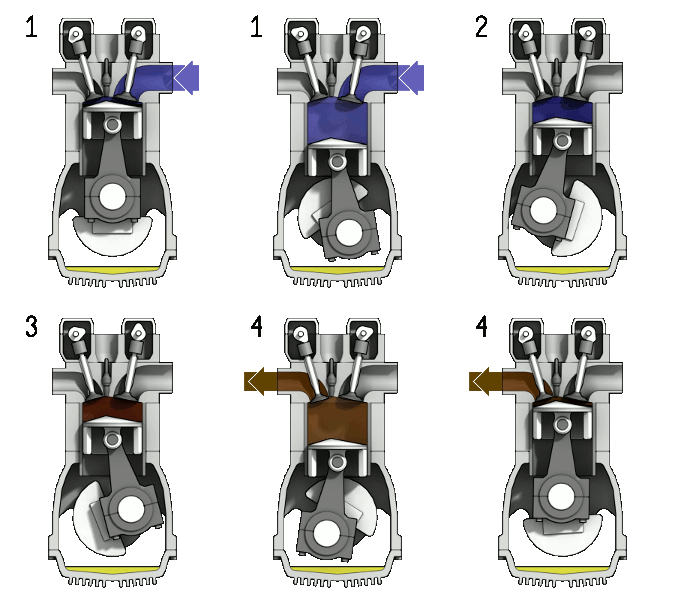
This animated image shows the four strokes in the engine cycle:
1) Intake 2) Compression 3) Power 4) Exhaust
Pay close attention to the subtle movement of the valves at the top of image. The exhaust valve is on the top left, and the intake is on the right.
During Intake, stroke the intake valve (top right) opens and the piston moves down. Air and fuel are sucked (or forced) into the cylinder.
For Compression, both valves close and the piston comes up, pressurizing the air/fuel mixture in the cylinder.
The Power stroke follows ignition, which happens when the piston is at Top Dead Center (TDC) of the cylinder at the end of the compression stroke. The burning expands rapidly, pushing the piston back down. Both valves are closed.
As the piston comes back up for the Exhaust stroke, the exhaust valve opens and the piston purges the cylinder of exhaust gases.
There is a power stroke once every other piston stroke.
Two stroke engines
By comparison, the two stroke engine only has an upstroke and downstroke.
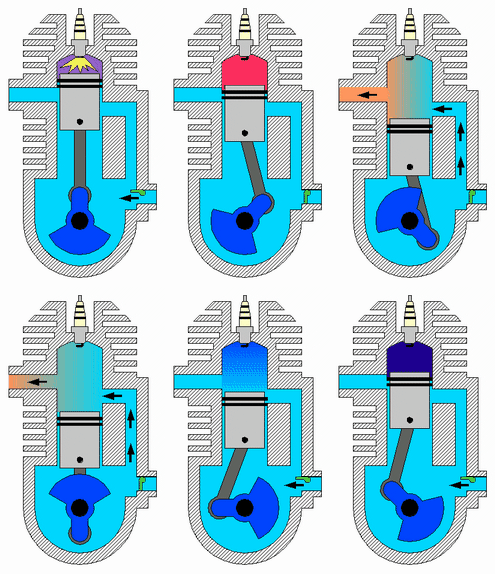
The two stroke engine has no valves like the four stroke, except a single reed valve at the bottom.
Intake and Exhaust happen at the same time through a process called scavenging, and there is a power stroke every time the piston moves up and down.
This simpler approach allows for much less complexity, but there is some inefficiency in the fuel burning that leads to lower efficiency and higher pollution.
Valves, Cams, and Timing
In the two animations above, it’s quite clear there’s a lot more going on in the four stroke engine. Most obvious are the valves opening and closing.
Cams and Valves

Own work based on source image, CC BY-SA 3.0, via Wikimedia Commons

Stahlkocher, CC BY-SA 3.0, via Wikimedia Commons
In the cutaway picture of the piston cylinder on the left, you can see the valve mechanism. The valve itself is a flat cap on a long stem with machining on the end to connect to the other parts in the assembly.
The valves rest on a spring, and on top of the valve are those egg-shaped pieces of metal. Those are the cams, and they rotate. As they rotate, the pointed end (the lobe) spins around and pushes down on the top of the valve. This forces the valve down and opens it.
As the cam continues to spin, it releases pressure on the top of the valve and the spring pushes it back up, closing the valve. As cams rotate, their precise shape opens the valves for a specific amount of time and distance.
The exhaust and intake valves must open at precise times in the four-stroke cycle. If the intake valve is closed during intake, no air will come in. If the intake valve is open during compression, all the air and fuel will blow back out the open hole. This will prevent any pressurized air and fuel from burning in the power stroke.
The Camshaft
By placing all the cams on a rotating bar, the camshaft, pictured on the right above, manages the timing of valve opening and closing. Some engines may use more than one camshaft. The cutaway example above is a Dual Overhead Camshaft (DOHC) configuration, common in many cars. These engines often have two intake and two exhaust valves to keep synchronized.
Mechanically tying the camshafts’ movement to the crankshaft synchronizes them with the pistons. If the movement of the pistons is kept in lock-step with the movements of the camshaft and the cams machined properly, the result is a clockwork timing between the up and down motion of the pistons on each stroke and the opening and closing of the valves.
Timing of the valves
Of course, it’s never quite that simple. In early engines, engineers geared the camshaft to turn precisely with the pistons. But years of engineering, experimentation, and testing have shown us that there are different valve timings that work optimally at different engine rotation speeds. Many modern engines will make subtle alterations to the valve timing to adjust for optimal power output and fuel consumption over a range of RPMs (revolutions per minute).
Keeping it Cool
If you look closely at the two pictures above, you’ll notice the four-stroke cylinder has a bit of yellow at the bottom, which the two-stroke does not. That represents the engine oil.
Even at idle speeds for most outboards – around 800-900 RPMs – the crankshaft is moving very fast, spinning thirteen to fifteen times every second! For every revolution of the engine, the pistons move up and down, the valves open and close, and a lot of metal rubs on metal. Even without the constant burning of gasoline or diesel in the chambers that will generate a lot of heat and metal wear.
The solution is lubrication, and two strokes and four strokes handle this differently.
The four-stroke engine has a reservoir of oil in the bottom and an oil pump to circulate the oil throughout the engine. This keeps all those moving parts bathed in a thin layer of oil. This prevents heat buildup and reduces friction to almost zero. It is essential to the continuing operation of the engine. Without engine oil, all the metal parts rubbing together would quickly overheat, and the engine would seize.
But the two-stroke does not use an oil reservoir. Instead, you mix the oil into the gasoline, and the fuel/oil mix bathes all the moving parts as the engine runs. It’s much simpler, and you never have to change the oil; you just have to keep adding it to your fuel.
Gasoline (unlike diesel) has no lubricating properties, so oil is absolutely necessary or the two-stroke will seize. You must never forget the oil or run out. But that oil in the fuel mixture does not get completely burned off, and oil and fuel residue is a large part of the pollution problem with two strokes.
Two-stroke engines have higher RPM ranges, and the lubrication doesn’t protect quite as well as a constant bath of dedicated lubricating oil. These are some reasons for a longer lifespan for the four-stroke.
So why couldn’t my wife start the four-stroke?
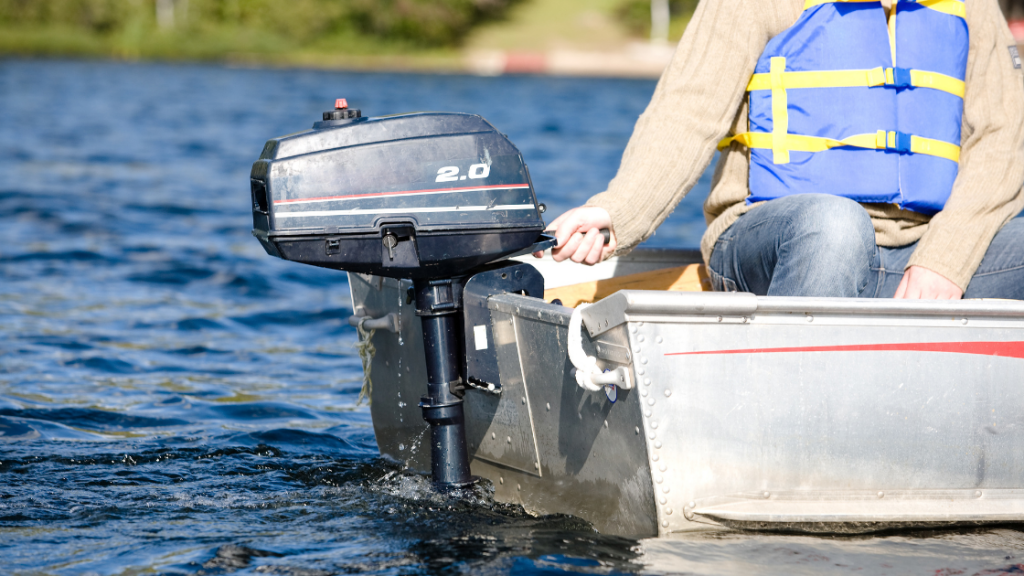
That’s the natural question through all this – how could my wife so easily start the higher horsepower two-stroke but not the four-stroke? Mostly it comes down to the extra moving parts and the mass of metal that has to get spun up.
With the camshafts, valves, oil pumps, and other extra machinery needed, the four-stroke engine has from thirty to fifty additional parts that have to spin. And when you’re starting an engine with a pull, you must turn all that extra mass of metal when you pull the cord. And a cold engine doesn’t have a layer of warm oil covering everything and making it slippery, as most of the oil runs back into the reservoir as the engine cools.
One other difference is the compression ratio in the engines. During the compression stroke, the piston pressurizes the air/fuel mix. A four-stroke engine typically uses slightly higher compression pressure than a two-stroke, and the compression cycle pressurization is longer. This extra pressure makes it harder to pull.
While both engines weighed about the same, the higher power two stroke had a lot fewer moving parts to pull with that cord.
Is one type of engine inherently better than the other?
The two-stroke versus four-stroke argument is long enough to make its own article. A quick good search will turn up many hits on this exact topic, and you can find arguments in favor of either.
What’s important is what you are planning to use the engine for. Is it for a dinghy engine that you will lift on and off the boat? Or part of a matched set of large HP engines for an open console fishing boat you’ll take offshore? Or maybe to power a twenty-two foot sailboat on a transom mount, or for a bass boat on freshwater lakes where two-strokes are mostly banned?
Advances in clean two-stroke technologies have offset some of the pollution disadvantages, so it really depends on how you intend to use the boat. And so the more you know, the better!

Leave a Reply