
Intro to Racing: The Skill and Craziness of Rounding Marks
June 3rd, 2026 by team
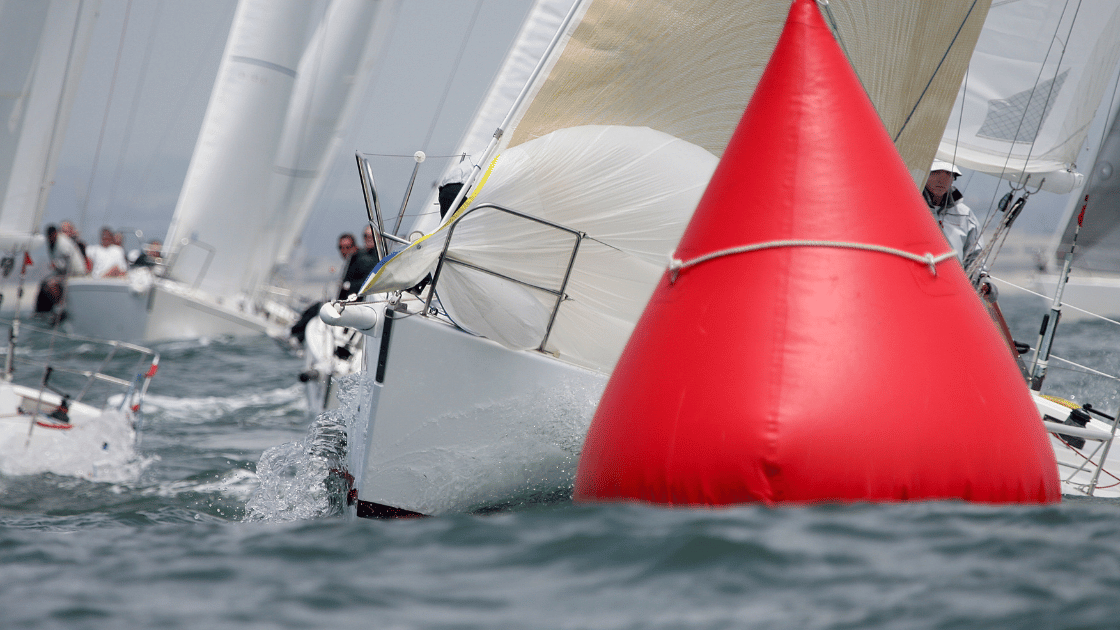
Part1 – Intro to Racing: Making Sense of the Start
by B.J. Porter (Contributing Editor)
“The chance of mistakes are about equal to the number of crew squared.”
– Ted Turner
If you thought the start was fun, wait until you come into your first mark rounding!
Imagine all those boats milling around at the start are now approaching the same mark in the water a mile or more upwind or downwind. If it’s a one-design fleet, the boats are about the same speed. While crew skill and tactical choices will spread the fleet, you’ll still have a lot of boats converging on the same point in the water around the same time.
Of course, there are rules that govern how all this happens. As we saw at the start, the rules surely guarantee an orderly procession around the marks with no yelling or jostling, right?
There’s a lot going on in and out of the boat, and we’re here to make some sense of it for you.
What is a mark? (And what’s so special about rounding it?)
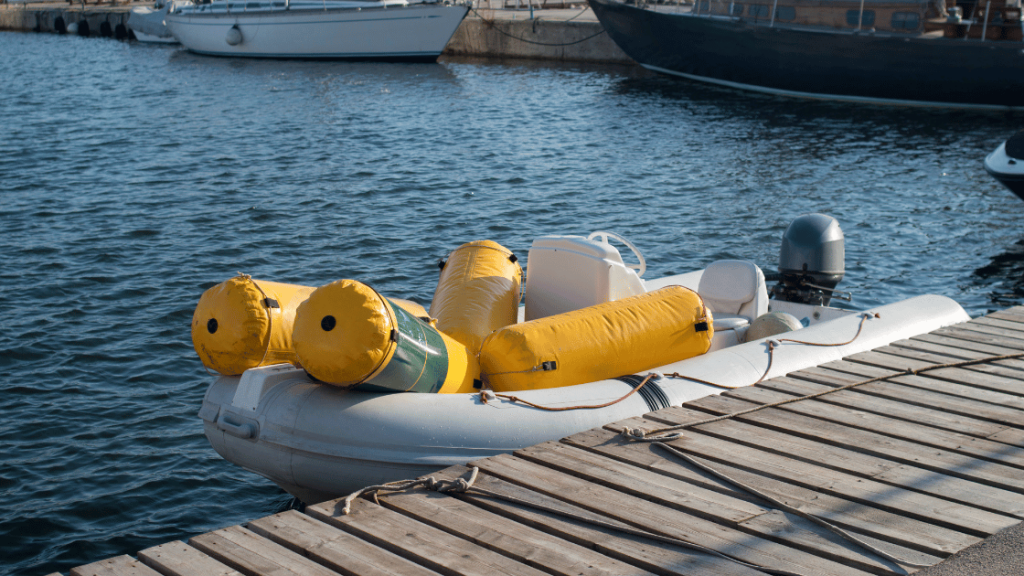
From the Racing Rules of Sailing (RRS):
Mark An object the sailing instructions require a boat to leave on a specified side, a race committee vessel surrounded by navigable water from which the starting or finishing line extends, and an object intentionally attached to the object or vessel.
However, an anchor line is not part of the mark.
An anchored float, a dropped buoy, a government mark, a private buoy, or nearly any other fixed object that the Race Committee (RC) specifies can serve as a mark.
How marks are used
Marks define the course, and in plainer language than you’ll find in the RRS, you must pass every single mark on the course in the correct order and on the correct side. If you start successfully, pass every mark correctly, and cross the finish line, you’ve completed the course.
A boat may never touch a mark. A boat that touches a mark must take all appropriate actions or penalties. “Boat” means any part of the boat, so even if you round a mark with the hull well off the mark but you’re trailing a line that touches the mark, you touched the mark and must take a penalty. (Penalties usually require the boat to turn in a circle before proceeding on the race, which is slow, though some events use scoring penalties.)
In a race with a simple windward-leeward course, there will typically be a windward (upwind) mark and a leeward (downwind) mark. Some courses may have other marks on them, for example, in distance races or races with Olympic triangle courses.
For most buoy races around inflatable marks on windward/leeward courses, keep the mark to the port side of the boat. But there are special cases, and you should always check the sailing instructions to make sure you understand the course and mark rules. This is especially true of point-to-point and distance races, where marks set require navigation choices so everyone sails the same course.
Even if you aren’t driving the boat or calling tactics, you need to know what is going on so you can be ready to do your job correctly.
What is a “Rounding?”

Usually, a mark on a course also means a change in heading, and often the change is sharp enough that you will have to make sail changes, or at least tack or jibe the boat.
Rounding a mark is the act of sailing into the mark and turning to the next mark. During this rounding, your boat may interact with other boats. And your crew may be very busy changing sails or trim.
A good mark rounding can give you a big strategic gain in a race, and bad mark rounding can be a disaster that knocks you out of contention.
Mark rounding is so important it has its own rule in the RRS, Rule 18, which lays out all the situations where boats must give way and give room. It’s worth reading, but it sounds a bit confusing the first time.
What’s going on in the boat
The plan for a race will shift with wind and conditions, but as your team approaches a mark, you will have a strategy. This may include things like how to set the spinnaker or what sail changes need to happen, as well as how to avoid or gain an advantage over other boats.
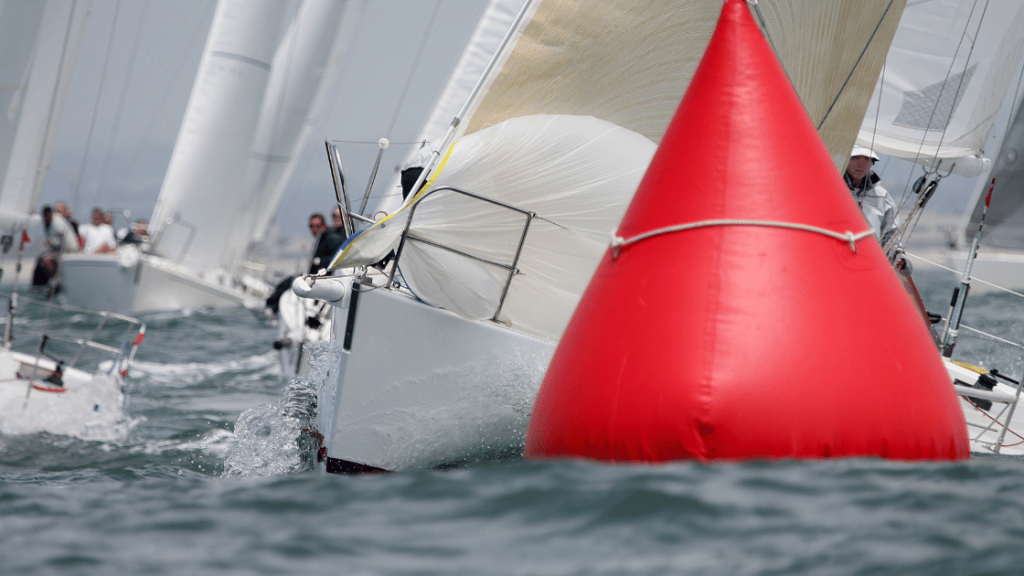
Before the mark
Once the sail changes for the mark rounding have been called, all crew get ready for the rounding. Everyone should have a job and know it. Sails are prepared to launch, and the person on the bow will set everything up and double-check it with help from others if needed.
The tactician will try to judge the layline, an imaginary line at which the boat should tack or jibe to fetch the mark with no more maneuvering. Sailing past the layline is inefficient, but turning before it can mean extra tacks or jibes to get to the mark.
As the boat approaches the zone, the crew will determine if there are any boats that will be given mark room, and how they will thread their way through the pack of boats rounding at the same time.
While rounding the mark
The RRS defines the Zone as a circle of three hull-lengths in radius around a mark.
Zone The area around a mark within a distance of three hull lengths of the boat nearer to it. A boat is in the zone when any part of her hull is in the zone.
There are specific rule changes in the zone outlined in Rule 18. Boats approaching the zone, in the zone, and exiting the zone must comply with all the rules.
Mark-Room Room for a boat
(a) to sail to the mark when her proper course is to sail close to it
(b) to round or pass the mark on the required side, and
(c) to leave it astern.
Sometimes there is…heated discussion…between boats about who has the right of way, who is entitled to room at the mark, or whether any fouls have occurred. If you are not the captain, tactician or on the bow, you shouldn’t be shouting at other boats. And even then, you need to be careful and know your rules. It can get hectic, and shouting incorrect rules and interpretations can cause problems and protests.
While the tacticians and sea lawyers are figuring out who gets mark room and who has the right of way, the rest of the boat is scrambling with a number of other tasks. These may include:
- Raising new sails as the boat jibes or tacks around the mark
- Dropping sails that won’t be used on the next leg
- Executing the steps of the tack or jibe at the right time in the proper order
After the mark rounding
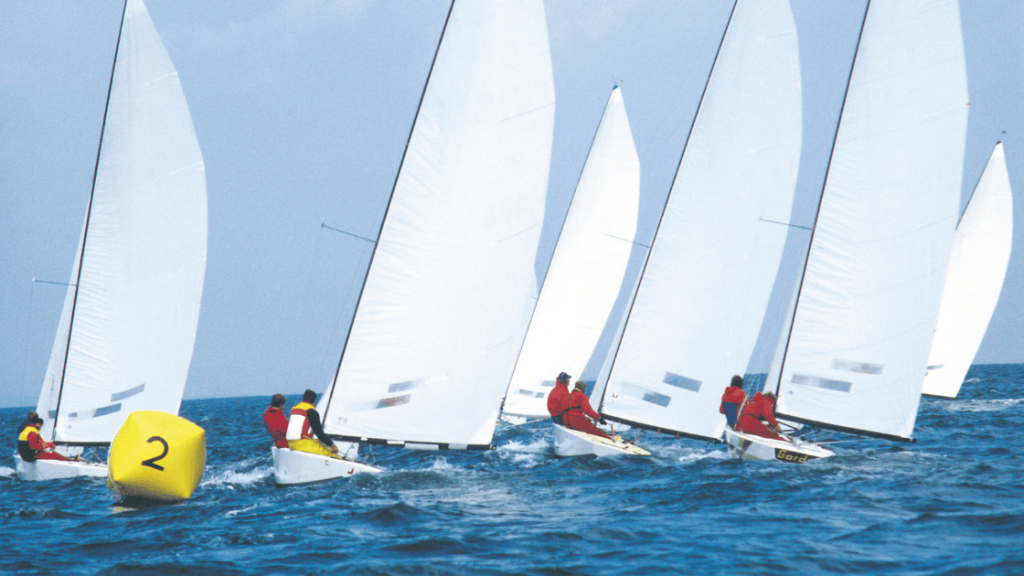
The mark rounding itself is usually fast, and can get chaotic if there are many boats in the mix. Especially if boat handling mistakes or rule violations happen in the frenzy and rush.
The first thing most crews do is get the boat settled in, trimmed, and dialed in to the new course. But there may also be imminent tactical considerations after the rounding.
For example, your boat might end up immediately downwind of another boat on the spinnaker leg, slowing the boat as the spinnaker keeps collapsing from the bad air. The tactician may call for an immediate jibe to get clear of the other boat. Usually coming out of a rounding, the tactical team will take a quick appraisal before telling the crew to clean up and get organized and settled.
So once the boat is clear of immediate tactical situations, the crew tidies up lines and sails to get ready for the current leg and the next rounding. As crew members complete their tasks, they take their positions for the next leg.
Mark Rounding Variations
Simpler courses at smaller events use a single mark for rounding. But for larger events with many boats coming into the marks, the race committee may set up alternate marks to enable crowd control and keep roundings safer and less contentious.
These will be spelled out in the sailing instructions, and everyone on board should understand how the marks work for every leg of the course.
Leeward Gates
Sometimes the race committee sets up a pair of downwind marks called a gate. Boats have the option to round either gate, but the gates must be rounded on different sides. Coming down the course, the gate marks are rounded on the inside the course side of the mark.
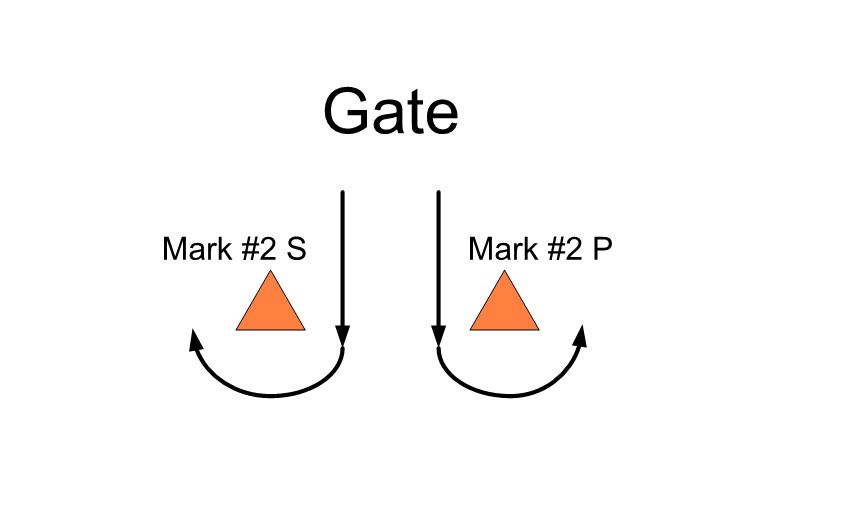
The diagram above, from the U.S. Sailing Materials for Race Officers content, shows how boats can round either mark. This can split the fleet in two and funnel rounding boats away from each other to reduce congestion at the mark.
Upwind Offsets
In larger events, race committees may use offset marks to manage traffic. With a single mark, boats will tack or jibe around the windward mark while setting the spinnaker for the downwind leg, and immediately head on their course. Boats jibing around the mark to set their spinnakers will head directly back into upwind traffic, which makes for too many exciting crossings as upwind boats approach the zone.
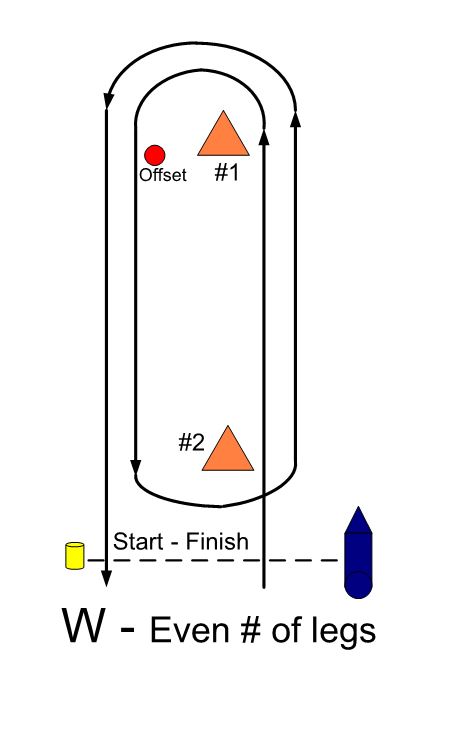
An offset, shown in the U.S. Sailing diagram below, is a second mark placed a short distance to the left of the upwind mark. It’s usually smaller and a different color to avoid confusion with the primary upwind mark. Boats must round the primary mark, then reach a short way to the offset mark and round it as well before bearing off and setting the spinnaker. This separates the downwind boats from the upwind boats enough to keep traffic clear.
Making Better Mark Roundings
Better mark roundings can only happen with good teamwork. And that takes practice together, repetition, and clear communication from the back of the boat to the front.
For you, as a new racer, there are a few things you can do to help your mark team around the marks more efficiently.
To make yourself the best crew you can, learn your job well. But also learn what others are doing, because you never know when an extra hand can help if things go sideways.
Take time before you get on the water to understand the courses, rounding rules, and expectations. If you know about things like offsets and gates before you see them on close approach, you won’t be surprised if the tactician makes a last-minute call for a jibe-set instead of a bear-away set because one leeward gate is clearly favored over the other.
Keeping your head in the game is a must, so you understand the tactical situation as your boat converges on a mark with a dozen other boats. You want to be able to anticipate, not react, when it comes time to do your job.
And finally, take time to learn the rules – especially Part 2, When Boats Meet and the Definitions. If you learn the rules, what’s happening on the water will be much clearer. The better you understand what is happening and why, the better you will help get your team around the mark quickly and without mistakes.

Leave a Reply