
Intro to Racing: Making Sense of the Start
April 10th, 2026 by team
by B.J. Porter (Contributing Editor)
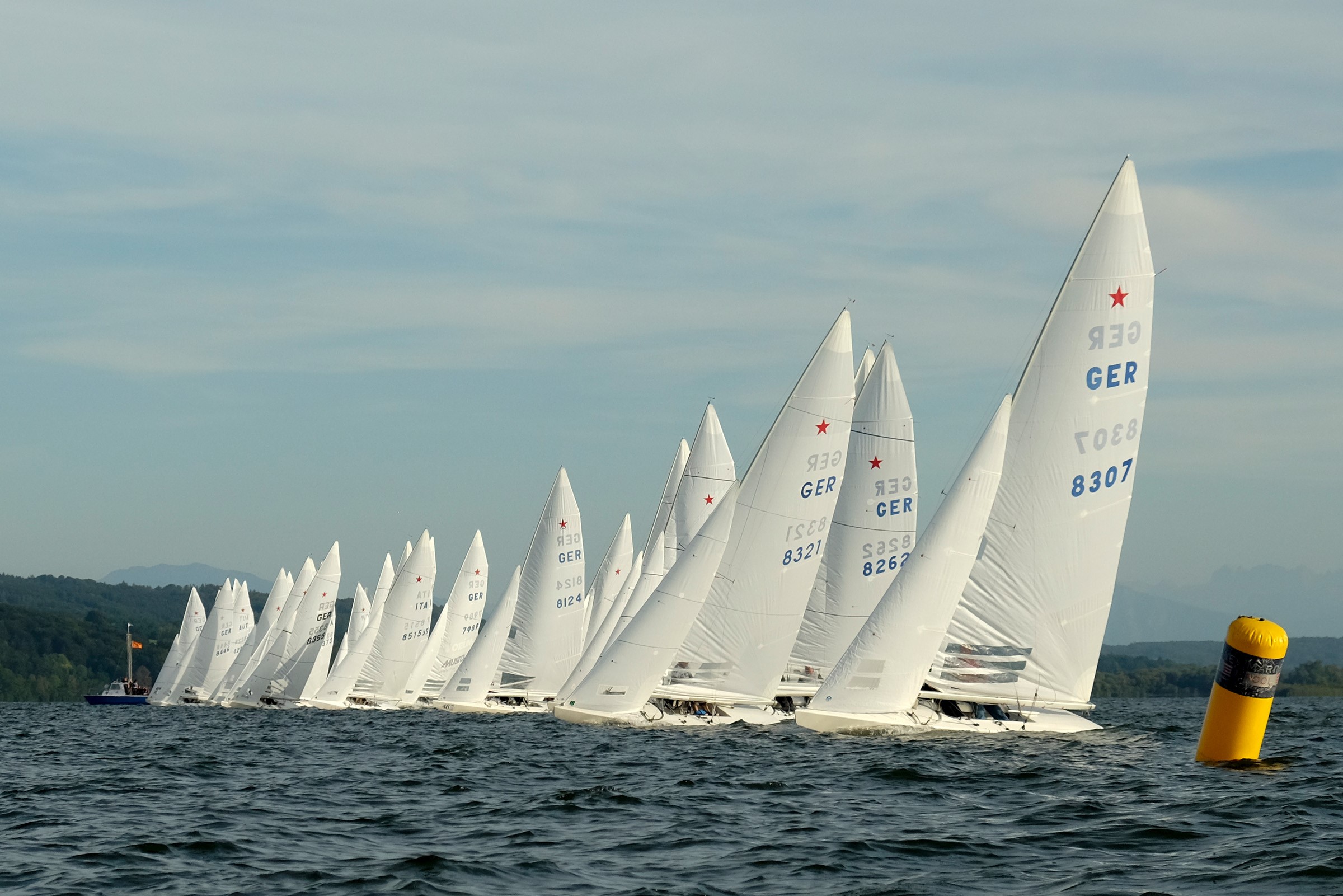
The first time you go through a start sequence in a race may leave you a little confused. There are guns firing, horns blowing, flags, people yelling, boats milling around, and it’s complete chaos. And in a moment everyone is sailing in the same direction, on the same tack, a lot fewer people are shouting, and the race is on!
What really happens during the most frenzied five minutes of a boat race? What is everyone trying to accomplish, and what’s all the yelling about? Does it really matter?
In a word: yes. A great start to a sailboat race is an immense advantage, and a terrible start can ruin your entire race. Holding off your pursuers is a lot more fun than clawing your way out of a deep hole.
The good news is that as a beginning racer, unless you’re sailing your own boat and don’t have an experienced racer helping you, you don’t have to figure out how to start yet. But as a crew member, if you know what’s happening, you can be ready to help the team hit the line perfectly.
Starting Objectives
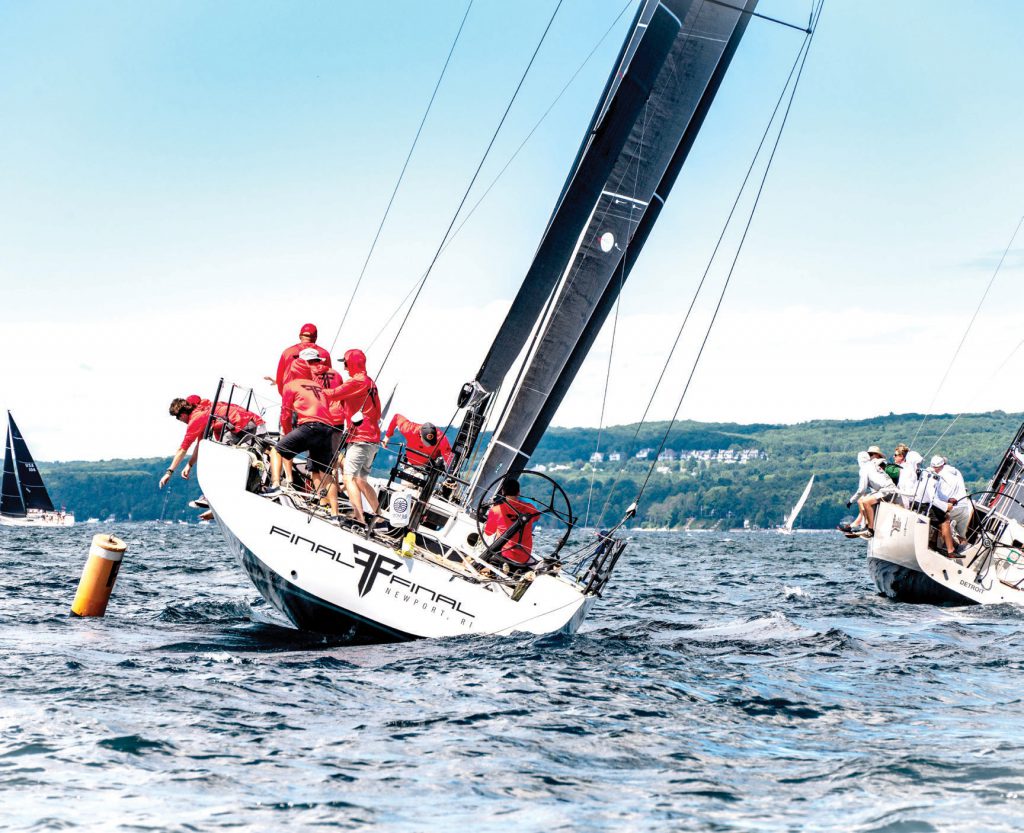
Every boat in trying to get the “best” start in the race. However, “best” is subjective, but it typically means that three conditions are satisfied for a good start.
- Hitting the starting line at full speed exactly at the start.
- Getting the favored end of the line.
- Having clear, undisturbed air.
The priority of these three conditions is subject to debate. You can consider them equally important in most situations., but your crew may think differently.
And there may be other considerations, such as positioning yourself near a specific competitor or setting up a meet a larger strategic plan for the race. But for most starts, full speed, a favored position, and clear air are the primary goals.
The Favored End
The favored end of the line is the end “closest” to the next mark based on the wind direction.
Most race courses should have a windward mark that is straight upwind from the start line, with the start line perpendicular to an imaginary line to the mark. The race committee tries its best to set the windward mark this way, and they might give a course to the mark as “078 Degrees, 2.0 miles.”
In this example, the wind is from 78 degrees on the compass, and the mark is two miles straight upwind. In theory. Because the wind is rarely stable, and it also rarely cooperates.
Now suppose there is a twelve-degree shift to the right, and the wind is now coming from 90 degrees. The starting line hasn’t changed, but if you sail directly upwind, on one tack you will sail much closer to the next mark than on the other tack. The slight shift in the wind has made one end of the line favored, because if you start at that end of the line you will have less distance to sail than if you start at the other end.
Of course, the wind constantly changes, and what looks like a favored end could be a short oscillation in the wind direction. But if there’s a big favor at one end of the line, everyone will fight for it.
Clear Air
In a big fleet, it’s easy to end up in the second row, with other boats to windward of you. This is really, really slow. The boats ahead of you roil, disturb, and slow all the wind you receive, gassing you underneath them.
And even a boat right next to you, either upwind or down, can affect your air depending on where it is relative to your boat.
So the tactician is aiming for as much clear, undisturbed air as possible. This means no boats upwind of you or overlapping you, messing up your air.
Full Speed
Why wouldn’t you hit the line at full speed? Just sail fast the whole start, right?
Well…not so fast there. If you’re seeking the favored end and clear air, you’re trying to position your boat precisely relative to other boats and the starting line. And there are rules about who has the right of way and who has to give way, so you can’t just go blasting through the fleet at full speed unless you are completely certain you can do it without fouling anyone.
What most sailors do is slow down through the start, jockey for position, and work their way to where they want to be as the start timer counts down. When they’ve set up their start, they speed up as the last seconds count down to hit the line with full speed. You must not cross the start line before the starting signal, or a penalty will leave you far behind the rest of the fleet. So timing the start with full speed is tricky, since starting too early can be much worse than starting a few seconds late or being slow off the line.
How this works varies a lot with the boats being sailed. A small dinghy like a Laser goes from barely moving to full speed in a couple of seconds. But a 15,000-pound keelboat with ten people on board takes a bit more time to get up to full speed.
Strategic Objectives
Sometimes big-picture objectives affect how you choose to start. For example, in the last race of a ten-week summer series, our boat was slightly ahead of another boat in the season standings. We were in 2nd place, and they were one point behind us in 3rd place going into the last week. Since they were a little faster, all we had to do was keep between them and the finish line, or finish within a few seconds of them, and we’d beat them for the season. So favored or unfavored didn’t matter; what we had to do was start above them and sit on their clear air and stick with them the entire race. (Author’s note: we did not achieve this…)
In another situation, the weather might predict a major wind shift over the course of the race. Ignoring a pin-favored line and choosing the other end to set yourself up for that shift may be a sounder strategy than fighting everyone for the pin.
So while pin position and clear air are critical to most starts, sometimes you have to do something else, anyway.
The Starting Sequence
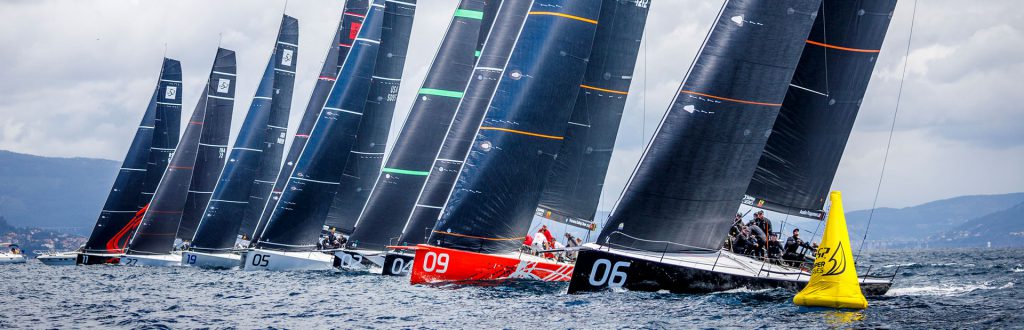
The committee signals a starting sequence with flags and sounds, and the flag serves as the “signal of record” for race timing. The start should proceed even if the committee misses or messes up a sound. The flags still count.
Before the starting sequence, there are a few other sounds and flags the race committee might use to communicate things like course changes, delays and postponements, and other information that changes the on-water schedule.
Also, before the start of racing every day, most committees require an on-water check-in by each racing boat. This is usually a quick sail by the committee boat, while someone yells out “Checking in!” and the sail number. This is to help the committee check their registered boat list against who actually showed up, and different races have different protocols.
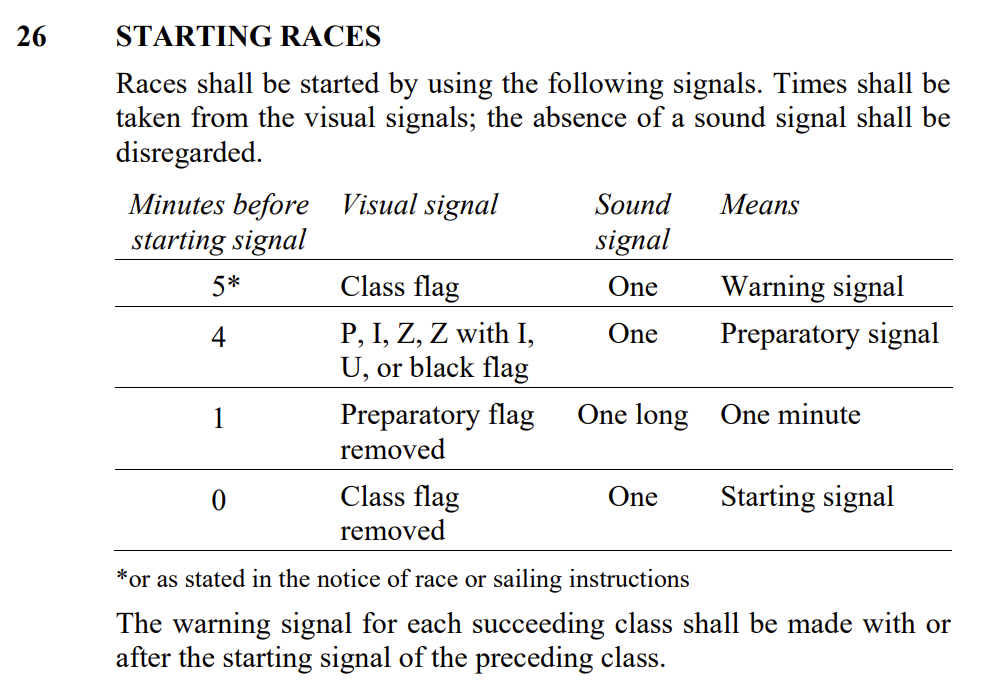
Above is the exact start sequence as defined in the current RRS (Racing Rules of Sailing, 2025-2028). And below, we have the definition of when a boat is racing.

The start has four distinct stages, with sounds and flags showing racers where they are in the start sequence. Good racers have timers on board, matching the start time, so they can time everything and hit that line as the starting signal is made.
Signals may vary by race committee. Some use guns or cannons; others use horns. Most use a long horn for the one-minute warning. In large events with many classes, the race committee will often use “rolling starts,” where the Starting signal for one class is the Warning signal for the next one.
Warning
The warning flag is the class flag for the group of boats starting in this sequence. It’s often a number flag flown from the backstay, though some races may not require flags (like weekly club series where everyone knows what class they’re in), or may have special class flags for an event.
While in the Warning, boats are not technically racing. They must comply with the rules of navigation and safety, but for that one minute all the Racing Rules don’t fully apply. For example, running your engine will not cause a penalty.
Preparatory
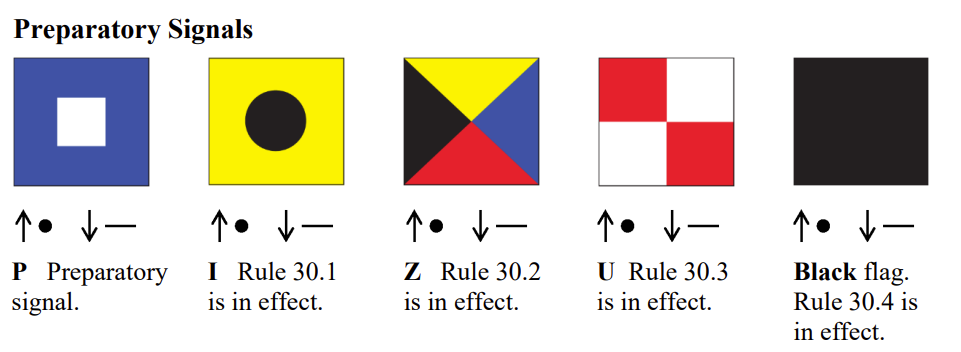
The Preparatory signal is the true start of racing. The “P” flag is hoisted with the Class flag, and all the RRS are now in force.
Besides the P flag, the race committee may hoist additional Preparatory flags including I, Z, U, and a black flag. These invoke specific rules about what happens to boats which are over the start line early, and how the start line is handled in the last minute of the start sequence.
One Minute

With one minute left, a long sound is made and the Preparatory flag is removed. This is the last signal before the start. If there are any flags left from the preparatory signals, they are still in effect.
Start
At the start, the race timer reaches zero, and the class flag is lowered with a sound signal. Racing is on, and boats may cross the line and start!
Post Start
After the start, the race committee may take a couple of more actions.
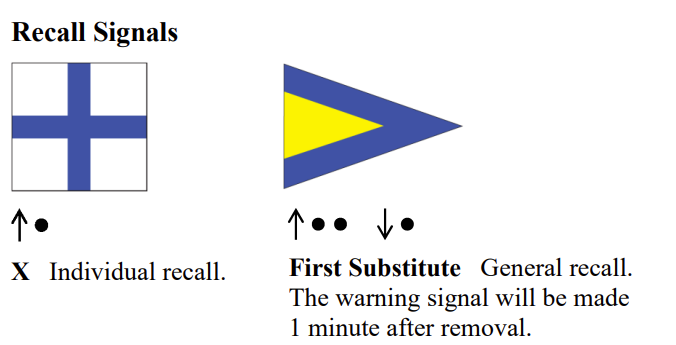
Individual Recall – if the race committee flies an X flag and makes a sound, that indicates that at least one boat was over the start early (known as OCS, or “On the Course Side” at the start), and is recalled. Note that the race committee is not obligated to state which boats are over early; it’s up to the skippers to know it was them. However, some committees may opt to read sail numbers over the radio or shout them to passing boats. But they are not required to; they will normally just leave the X flag until all OCS boats have started again.
General Recall – If too many boats were OCS for the race committee to identify them all exactly, they may restart the entire class. This will send the class back into another start sequence. If there are too many general recalls for the class, the race committee may impose more aggressive start penalties with the I, Z, U, or black flag rules to encourage everyone to stay on the proper side of the line before the start.
Making Better Starts
Making better starts is the subject of many books and articles, and is way too large to tackle here in this article. However, there are things your captain and tactician will do around the starting sequence with this aim, and it’s good to know what they might be.
- Finding the favored end of the line. You’ll see boats doing “wind shots,” where the helm turns the boat straight into the wind. Someone will note the wind compass direction, or it will be clear there is a favored end, or no favored end. This information will be used to choose were to start on the line.
- Pre-race strategies. Information on weather, wind, tides and currents, local knowledge, and specific competitors will go into a strategy for the day’s racing. This strategy may not survive much after the start (especially if the start doesn’t go as planned), but it will often factor into how the team wants to start the boat.
- Crew work is critical. Quickly getting the boat dialed in from luffing and nearly drifting to full speed with steering is a key part of timing starts. As is communication.
What you can do
How can you help your team get the best start?
- Know your job. It comes down to teamwork and boat handling; if you do your job well the boat and crew can respond quickly. So practice and learn as much as you can every week and between races.
- Pay attention. Things happen really fast at the start, and quick changes in tactics and strategy happen on the fly as boats mill around and push for position. There is no time to waste, so if you can do your job with anticipation instead of delayed reaction because you’re watching the clock and the other boats, it will go better.
- Stay quiet. Unless it’s your job to say something or you have a question you must have answered to do your job during this start sequence, don’t talk. Communication between the helm, tactician, trimmers and bow is crucial. Race starts are noisy places, and you might be tempted to scream and yell about something if you’re alarmed. It really looks like a full-on melee, with boats nearly rubbing, touching and hitting, and it can be quite alarming if you aren’t used to the scrum. Stay calm and quiet.
- Learn the rules. The more you know about what’s happening, the more helpful you can be. You will experience fewer surprises, and your response times will improve.

Leave a Reply