
Can You Earn Money With Your Boat?
May 12th, 2026 by team

by B.J Porter (Contributing Editor)
When considering boat ownership, everyone looks at the costs. And a very common question is, “Can I take a few paying people out on my boat or rent it out when I’m not using it to offset some of these costs?”
The quick answer to this is “maybe,” because there are a lot of factors that go into whether this is something that will work for you. Some are strictly legal roadblocks – your boat may not qualify for charter or passenger operations. But most are operational because there are a lot of obstacles to setting up a safe, legal boat charter business.
So it’s not always a question of can you hire your boat out or take trips, but whether it’s worth it financially.
NOTE: For this article, we’re talking about chartering in domestic waters in the United States unless otherwise specified. The details and rules may vary quite a bit in other countries.
The elephant in the room – insurance

No matter what you decide to do with your boat, you will need to upgrade your insurance from your recreational boat policy if you’re planning any commercial activity. Read the fine print on your policy. Almost every recreational policy excludes damage caused by any commercial use of the boat.
Many insurance companies will also have rules about qualified operators of the vessel, and may refuse to honor claims made if the owner was not on board while someone else operated the boat with their permission.
There’s a lot to consider on the insurance front, but the primary rule is: do not conduct any paid trips of any kind on your boat until you have reviewed your insurance with your agent.
What type of charters or trips are you considering?
There are a few ways you can try to make some money with your boat, and they have different considerations for what you need to do to get going.
The most common are bareboat chartering, crewed charters, and running specific trips, like fishing trips or eco tours with you or someone else as captain and crew. You may need different licensing and paperwork from multiple entities no matter which you go with.
Bareboat charters
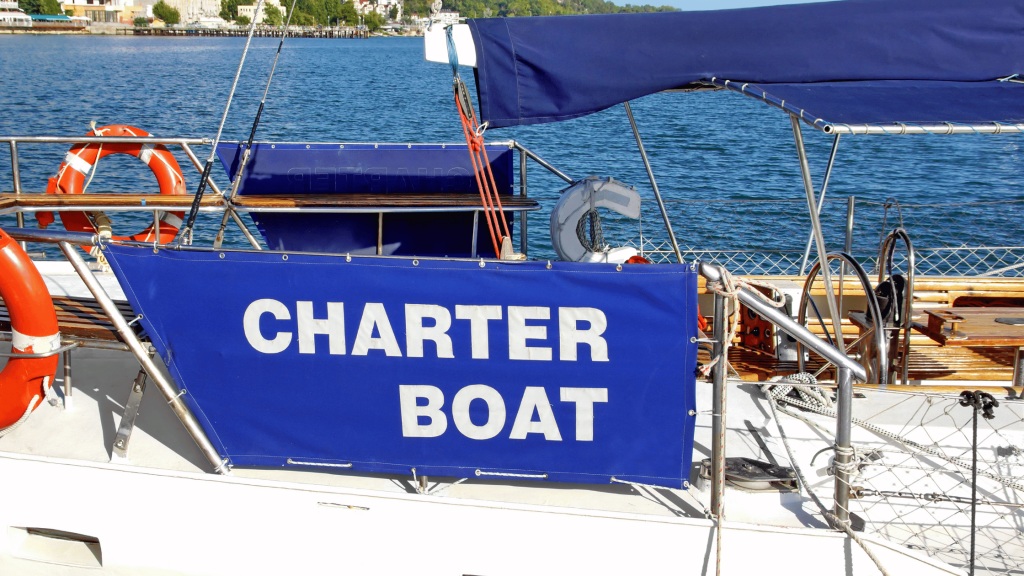
Bareboat charters are the simplest model, where all you do is rent your boat out to someone else, and they use it.
Many people have a problem with this because you’re letting a total stranger take your boat. Some people won’t treat a boat or any asset they’ve rented with anything like the care you would. It’s something I could never do with any of my boats!
But even if you are fine with turning your boat over to a stranger, there are other considerations.
First, you must assess their skills to be sure they can handle your boat. This can be tricky because sometimes people will overestimate or misrepresent their experience and skills. Even credentials and certificates aren’t a guarantee that the person who wants to charter your boat can really handle it, so you have to check them carefully.
If something happens because of the incompetence of a charterer you checked out, it can give an insurance company grounds to fight your claims because you didn’t vet them properly. And if something on the boat breaks because of the negligence of the person you rented to, you’ll have to pay for whatever the damage deposit you collected doesn’t cover. (You did collect a damage deposit, right?)
You also need to be ready to support your boat if there is a problem. This may be easy if it breaks down leaving the dock, but not so much if they’re a long way from where you live or offshore someplace where you can’t get out to them.
There are many companies operating all over the world who manage charter fleets of boats that they helped people buy. As the owner, you can visit your boat and use it, but they will keep it in service as a charter when you’re not on board. This can significantly offset the cost of ownership. While the details are outside the scope of this article, this can be a viable way to buy a boat in a pleasant location if you don’t plan to use it that often.
Crewed charters
A crewed charter is a charter with a hired captain and crew. What a great way to do it! Instead of handing the keys to a random stranger and letting them run your boat up on the rocks, they can rent your boat and then hire you to captain it for them!
Except…that’s not really a charter anymore, and different rules apply unless you give the charter party the right to hire any captain and crew they want, not just you. See the next section.
If you are the only allowed captain, then you’re really running a passage or trip, not a charter, and the regulations you must follow are different.
For example, a bareboat charter may have up to twelve people on it. But if you are a captain with an OUPV (Operator of Uninspected Vessels (OUPV) license, you may only run a trip with six passengers. To carry more than six passengers, the coast guard must inspect the vessel, and you must have a Master’s license instead of an OUPV.
You can make this work, but you must take care that you’re following the law carefully so you don’t run an illegal charter. And you have to let your boat go out with any captain the charter customer chooses, not just you. That’s a non-starter for most boat owners.
Commercial trips

Taking strangers fishing, or sailing to a specific place, or anything where you’re taking passengers for hire, is a commercial trip. This means eco-tours, taxi services, or just a day out sailing. If they are paying to be on your boat, they are passengers.
To do this legally, you need a captain’s license. If you want to take over six passengers at a time, you will need a Certificate of Inspection (COI) for your boat and a Master credential for yourself.
A COI is a big deal to get, and can be very expensive and require modifications to your boat. It’s the major reason, along with the Master credential requirement, that you see so many six-person charter trip limits. The OUPV, or “six-pack” credential requires less sea time, less training, and less testing. But you can never take more than six passengers with it.
While six-pack charters have equipment requirements, their focus on safety means they are not much more stringent than those for recreational use.
Other requirements
Depending on where you plan to operate, you may have to meet other local rules, permits, regulations, and business requirements. Check with the town, the marina you plan to work out of, the state environmental regulators, and any depart which regulates businesses in your area.
You will certainly want a legal structure to protect you and your personal assets, and you’ll need to file and collect any relevant taxes. It’s an excellent idea to have an accountant and/or an attorney set this up for you correctly.
Finally, you must enroll in a drug testing consortium to meet USCG requirements for drug-free operation.
Research all this for your home waters before you start down the charter path.
Jones Act and MARAD
Where was your boat built? If it wasn’t in the United States, you will have more paperwork ahead of you.
The Jones Act is a piece of legislation put in place over 100 years ago to protect domestic shipping and sailors. It requires that any vessel carrying passengers between domestic ports in the U.S. must meet several criteria.
- The keel must be laid in the United States
- It must be owned by a United States citizen
- Must meet all USCG safety requirements
If your boat was built outside the U.S., you will need to get a MARAD waiver to take passengers out on it.
To get a waiver, the boat must be over three years old, meet all the safety requirements for its commercial class, and it must clear a public notice period to make sure it’s not competitively harming a domestically built vessel. There are a few other factors as well, but obtaining a waiver can take several months, and there is no guarantee you can get one.
So before you spend a nickel getting your foreign-built boat ready for charter, make sure you can get the waiver!
What about expense sharing?
“Can I take my friends out fishing if they pay for gas?”
Generally, yes, groups of friends and family can some out on your boat and voluntarily chip in for fuel, bait, and so on. It’s a normal social use of your boat and that’s fine. It’s not a bad idea for you to kick in a share too, just in case.
Where it gets sticky is if you are taking people out you don’t really know and getting help with expenses. For example, if your boss asks you to take out some clients with him and offers to pay for your fuel. That’s pretty gray, and could get you into trouble since it’s not a normal social use of your boat; there is a defined business benefit for your boss and he is paying you for it.
You should be very careful when taking money for the use of your boat when it’s not your friends, family, or normal social group.
Penalties for illegal charters
In some waters there’s little or no policing of charters, and people certainly get away with taking the occasional paid group out for a sail or a day of fishing without being boarded by the authorities. However, if you are boarded by the USCG or a local policing agency, it can get very expensive in a hurry. Never mind if there is an incident where someone is hurt.
Taking paying passengers out without a captain’s license can cost you up to $10,000 per occurrence. You can also get dinged $5,000 per day that you run charters without being part of a random drug testing program. If authorities catch you operating illegal charters again after they issue a “Captain-of-the-Port Order,” you could pay over $100,000.
The Coast Guard can also revoke your USCG license (if you possess one), and they can refuse to grant you one in the future. If there is an accident, injury, or death on an illegal charter you are running, the criminal and civil liabilities can be staggering, and you could end up in jail.
And remember, ignorance of the law is no excuse. The USCG and the federal government are not interested in excuses for ignorance, and they will throw the book at you.
So…is that a yes or no?

We’ve made the whole “making money with your boat” concept sound a little intimidating here. That is intentional because the preparation and costs to get into it are high, and the risks are serious. Boating can be dangerous, and careless and illegal commercial operators not only make the industry look bad, but they are a danger to themselves and others.
So yes, you can find legal ways to make some money with your boat. But it is a serious undertaking, and you need to do your homework, get trained, and follow the rules.

May 17, 2026 at 11:41 am, Dan said:
Thanks for the information. Very informative.